How Barbaric!

The changing views of outsiders in the later Roman Empire, from Ammianus Marcellus and his contemporaries

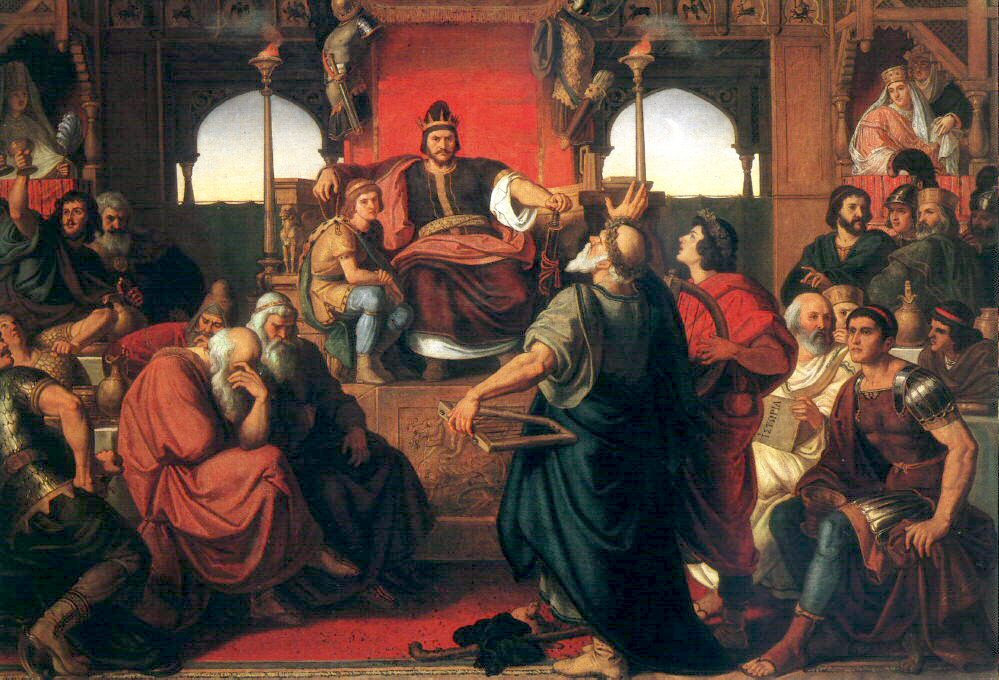
What makes a barbarian?[1] In the Greek sense of the word it meant anyone who wasn’t Greek, their native tongues just sounding like babbling to Greek ears, and this definition would include the Romans, even after the decisive defeat of Hellenisitc power following the Third and Fourth Macedonian Wars. This posed a slight problem to the Roman sense of superiority, but one that had been countered by Cicero, who in Republic posited that barbarism does not come from language but from manners, this not only conveniently expands non-barbarians to include Romans, but reinforces the divide between civilisation and ‘barbarism’.[2] In the 4th and 5th centuries CE as the barbarians started to become rulers in an increasingly porous empire the transformation of the term which would eventually lead to Jordanes stating that the Goths, who had come to rule Italy, were not barbarians either,[3] and that they were, in fact, natural allies to the Romans against the barbarism of the Huns.[4] Huns from a contemporary source:

They are certainly in the shape of men, however uncouth, and are so hardy that they neither require fire nor well flavored food, but live on the roots of such herbs as they get in the fields, or on the half-raw flesh of any animal, which they merely warm rapidly by placing it between their own thighs and the backs of their horses.

This lurid description comes from a key source from Late Antiquity for historians and classicists, in particular for its descriptions of the various barbarian peoples: Ammianus Marcellus’ work the Res Gestae, a history of the Roman Empire, done in the style of republican and early imperial figures.[5] Ammianus was from Antioch in the Levant, and likely to have grown up in a Greek family, despite his decision to write in Latin.[6] He was a military man and served in the armies of Constantius II and Julian.  Only a miniscule portion of his work, the Res Gestae, remains, which covers some 25 years, from 353-378 CE in a history which covered nearly 300, beginning with the reign of Emperor Nerva in 96 CE. But the text which does remain to us covers Ammianus’ own life, and we can see how his own experiences colour his view of the historical events depicted. Ammianus has been traditionally considered one of the most valuable sources from Late Antiquity, Edward Gibbons in his Decline and Fall of the Roman Empire praises him as ‘an accurate and faithful guide’[7], and his entry in the Oxford Classical Dictionary  describes him as ‘the last great Latin historian of the Roman empire’[8] In historical works from Antiquity, like Ammianus’, the description of barbarian invasions and conflict can be seen not necessarily as a clinical description of events, but more as a foil to contrast the leadership styles of Emperors, in this case Constantius II and Julian. Ammianus favours the more combative style of Julian than the more conciliatory Constantius.[9]

Ammianus’ description of the Huns is completely unlike when he described the Alamanni or the Sassanid Persians. Ammianus’ Hunnic digression comes not from his personal experience, but from second or third hand sources, and this is likely a factor as to why the passage makes the Huns to be more bestial than human.[10] His dehumanising of the Huns is common among the texts of this period; Greco-Roman writers used them as an example of unbridled rage and ferocity.[11] The only scholar available to us who had first hand interactions with the Huns is Priscus of Panium, who was part of a diplomatic mission to the court of Attila in the 440s CE, and who paints a vastly different picture to his near contemporaries of Hunnic culture. The multinational nature of Attila’s court, with Goths and Scythians in places of note among the Huns, and the prominence of women in society are aspects that Priscus found striking.[12] Guy Halsall states that Ammianus’ description of the Huns draws on descriptions of other peoples from the ends of the earth, and uses similar descriptors that he had used for the Saracens and the Alans, and uses topoi and phrases from Tacitus’ Fenni.[13] Eunapius, the Greek sophist, draws a connection of the Huns with the Royal Scythians from Herodutus’ History in an attempt to place them in the context of earlier Attic literature.[14] The assertion that they eat their meat raw is again tapping into a tradition among Greco-Roman writers when discussing barbarous groups, it is a trait attributed by Classical scholars to various barbarian tribes, as a habit that is a natural extension of barbarism itself.[15] Regardless of the novelty of Ammianus’ description of them, most of the scholars write about the Huns in a similarly awed fashion.

Peter Heather praises Ammianus as a source, as he shows much greater interest in a description of barbarians than many of his contemporaries.[16] While many Roman writers would treat the German tribes as unchanged since Tacitus writing in the 1st century C.E. it is through Ammianus narrative that the Alamanni political structure can be unpicked. Unlike in Tacitus where the various tribes were ruled without kings for the most part, and never hereditary, the Alamanni from Ammianus’ time have more stable governance.[17] He reserves the dehumanising of barbarians to those who fight against the Romans; those who serve Rome, either in the military or administration, he praises, such as the courage of Germanic soldiers, who increasingly made up sections of the Roman army.[18] Zosimus, the late 5th-early 6th century Greek writer, tried to downplay the presence of barbarians within Roman ranks,[19] while Sidonius Apollinaris in a letter to Syagrius the last Roman commander in Gaul, is amused by his friend’s learning Germanic, but chides him to not forget his classics nor his Latin heritage.[20]

Detail from plate of Sharpur II
Detail of a Sassanid plate featuring Sharpur II hunting. Exhibit in the Arthur M. Sackler Gallery, Washington, DC

Ammianus’ Sassanian Persians, displays the typical attitudes of Greco-Roman writers towards the Persians: the decadent Easterners, who are effeminate and ill-disciplined. He does however, praise them for their modesty, and meritorious in their choices for judges, unlike the Romans, in Ammianus’ view.[21] For him the Roman defeat at Persian hands in the Roman-Persian War of 364 could not possibly have been because of Persian superiority or even parity with Rome on the battlefield, but must be due to the timidity of Jovian, who becomes emperor following Julian’s death at the Battle of Samarra against Sharpur II. This view is shared with Eunapius, who celebrated Julian’s invasion of Persia, and puts the blame on the subsequent defeat and peace treaty on Jovian.[22]

This view of Roman superiority is complicated by the settlement of barbarians within the empire, the peregrini.[23] A number of laws dating from the reign of Valentinian I and Valens give the modern observer an idea of how the peregrini were treated under Roman law, such as a law from roughly 369 CE, which placed restrictions on commercial practices and trade with the barbarians and prohibited the trade of wine, oil, and fish sauce, all three of which were valuable commodities.[24] Another law which shows how the administration were taking steps against integration of the peregrini prohibited the marriage between Romans and barbarians,[25] and Theodosius’ treaty with the Goths in 382 settling them along the Danube explicitly prohibited conubium, the right to intermarry.[26] Despite these various documents how widespread the implementation of the law was is up for debate, as Ralph Mathisen argues,[27] and indeed through material evidence we can see how it was ignored; for example; on the headstone of his wife a Roman citizen from Florence calls her a civis Alammana, a citizen of the Alammani.[28] Jerome in his Epistles when writing on the death of the general Flavius Stilicho, reasons that his supposed betrayal of Rome and subsequent murder were an inevitability of his birth, as a half barbarian traitor,[29] and Bryan Ward-Perkins in his research found that there are many examples of Romans from Late Antiquity that considered that ‘barbarians were uncouth and beneath consideration, or indeed that the best barbarian was a dead barbarian.’[30]


Late Roman Migration Period deutsch
Late Roman Empire Migration Period map with German notations from wikimedia commons.


Salvian, a Christian priest from Marseille, is incredibly positive about the barbarians when compared to Ammianus and many other writers in the 4th and 5th centuries, at least on the surface level. Salvian wrote some 40 years later than Ammianus, in the 430s CE, and by that time the Western Empire’s control in Gaul is faltering, with the various barbarian groups gaining greater control of large territories, and increased civil unrest – with the revolt of the bacaudae, groups of peasant militias and brigands. In De Gubernatione Dei (On the Government of God) Salvian tried to answer the question of why this is the case, and why the civilising mission of Rome, and the evangelical mission of the orthodox church was failing. He uses the supposed innocence and harmony barbarians to juxtapose the sins of the Romans: ‘Almost all barbarians, at least those who of one tribe under one king, love one another; almost all Romans persecute each other’[31] This seems like high praise but he is using this strong rhetorical language in order to shock his readers, when writing about the bacaudae and their alliance with the his true feelings about the barbarians becomes apparent.[32] Unlike contemporary Christian thinkers, such as Paulus Orosius and Augustine of Hippo, Salvian does not place the blame for the ending of the empire solely on the shoulders of the pagans and heretics, but also on the inaction of Christians to convert the rest of the Romans. He is pessimistic in outlook, towards barbarians, the corruption of the Church, and the pagans and heretics in Rome.[33] Of the barbarians he states morosely: illi crescunt cotidie nos decrescimus, illi proficiunt nos humiliamur, illi florent et nos arescimus.[34] His defeatest sentiment cannot identify these barbarians as Christians themselves, despite them being Arians, as he strongly associates the Church with the Empire.[35] Salvian does share Ammianus’ and the rest of Roman society’s contempt for the barbarian, however, in his writing he is trying to reconcile the weakening of the empire with the supposed inferiority of the barbarian invader, and so, has to concede that the characteristics of the simplistic life of barbarian are better than the supposed sins of the hedonism of Roman society.

Ammianus’ description of the Huns as bestial men with ‘no need of fire nor of savoury food’ is very much in line with the prejudices and beliefs about barbarians in the Rome of Late Antiquity. The Roman sense of superiority in culture, character, and martial prowess to those outside the empire persisted despite the ongoing waning of the empire in the West, with traditionalist writers, like Ammianus and Eunapius still presenting  strength and advocating for aggressive Roman foreign policy, and Salvian and other Christian writers in spite of their dour outlook still found that the Christian piety of the Roman emperors meant superiority over pagan and heretical barbarians. Many of these barbarians would in time become the masters of Europe, and look on the Romans as their antecedents, and themselves as the inheritors of the Empire, Theodoric the Great with his Latin inspired building programmes and stylings in Ravenna, and Charlemagne taking the title of Holy Roman Emperor, declaring himself the true successor of Augustus.


Bibliography

  • Burns, Thomas S. Rome and the Barbarians, 100 B.C. – 400 A. D. Baltimore, 2003.
  • Cameron, Averil. The Later Roman Empire. London, 2013.
  • Gibbon, Edward. The History of the Decline and Fall of the Roman Empire
  • Halsall, Guy. Barbarian Migrations and the Roman West 376-568. Cambridge, 2007.
  • Hanson, R. P. C. ‘The Reaction of the Church to the Collapse of the Western Roman Empire in the Fifth Century’ Vigilae Christianae 26, no. 4 (1972), pp 272-287.
  • Heather, Peter. Empires and Barbarians: The Fall of Rome and the Birth of Europe. Oxford, 2009.
  • Maas, Michael. Reading in Late Antiquity: A Sourcebook. Oxford, 2010.
  • Mathisen, Ralph W. ‘Peregrini, Barbari, and Cives Romani: Concepts of Citizenship and the legal Identity of Barbarians in the Later Roman Empire’. The American Historical Review 111, no. 4 (Oct. 2006), pp 1011-1040.
  • Mathisen, Ralph W. ‘Provinciales, Gentiles, and the Marriages between Romans and Barbarians’. The Journal of Roman Studies 99 (2009), pp 140-155.
  • Matthews, John. The Roman Empire of Ammianus. London, 1989.
  • Matthews, John. ‘Ammianus Marcellanus’ in The Oxford Classical Dictionary
  • Moralee, Jason. ‘Maximinus Thrax and the Racial Politics of Late Antiquity’. Greece & Rome 55, no. 1 (Apr. 2008), pp 55-82.
  • Rohrbacher, David. The Historians of Late Antiquity. London, 2002.
  • Salvian. De Gubernatione Dei. c. 440.
  • Thompson, E. A. Romans and Barbarians: The Decline of the Western Empire. Madison, 1982.
  • Ward Perkins, Bryan. The Fall of Rome: And the End of Civilisation. Oxford, 2005.

[1] N.B. I will be dividing the barbarians into three broad groupings in this discussion, based on their different treatment by Greco-Roman writers: the Sassanian Persians in the Near East, the Germanic tribes beyond the Rhine and the Danube, and the third grouping of the Alans and Huns who appear in this period.

[2] Guy Halsall, Barbarian Migrations and the Roman West 376-568 (Cambridge, 2007), p. 45.

[3] Jason Moralee, ‘Maxinimus Thrax and the Politics of Race in Late Antiquity’ Greece & Rome 55 no. 1 (2008), p. 74.

[4] Bryan Ward Perkins, The Fall of Rome: And the End of Civilisation (Oxford, 2005), p. 36.

[5] David Rohrbacher, The Historians of Late Antiquity (London, 2002), p. 180.

[6] Rohrbacher, The Historians of Late Antiquity, p. 14.

[7] Edward Gibbon, The History of the Decline and Fall of the Roman Empire

[8] John Matthews, ‘Ammianus Marcellinus, c. 330–395 CE’ in Oxford Classical Dictionary

[9] Thomas S. Burns, Rome and the Barbarians, 100 B.C. – A.D. 400, p. 331.

[10] Rohrbacher, The Historians of Late Antiquity, p. 226.

[11] Rohrbacher, The Historians of Late Antiquity, p. 225.

[12] Rohrbacher, The Historians of Late Antiquity, p. 227.

[13] Halsall, Barbarian Migration and the Roman West, p. 172.

[14] John Matthews, The Roman Empire of Ammianus (London, 1989), p. 335.

[15] Matthews, The Roman Empire of Ammianus, p. 337.

[16] Peter Heather, Empires and Barbarians: The Fall of Rome and the Birth of Europe (Oxford, 2009), p. 37

[17] Heather, Empires and Barbarians, p. 39.

[18] Rohrbacher, The Historians of Late Antiquity, p. 232.

[19] Burns, Rome and the Barbarians, p. 335.

[20] Sidonius, Letter 5.5 trans. W. B. Anderson (Cambridge MA, 1965) cited in Michael Maas Readings in Late Antiquity (Oxford, 2010), p. 352.

[21] Rohrbacher, The Historians of Late Antiquity, p. 209.

[22] Rohrbacher, The Historians of Late Antiquity, p. 210.

[23] Ralph W. Mathisen, ‘Peregrini, Barbari, and Cives Romani: Concepts of Citizenship and the Legal Identity of Barbarians in the Later Roman Empire’ The American Historical Review 111 no. 4 (2006).

[24] Mathisen, ‘Provinciales, Gentiles, and Marriages between Romans and Barbarians’ The Journal of Roman Studies 99 (2009), p. 141.

[25] Mathisen, ‘Marriages between Romans and Barbarians’, p. 67.

[26] Averil Cameron, The Later Roman Empire (London, 2013), p. 138.

[27] Mathisen, ‘Marriages between Romans and Barbarians’, p. 143

[28] Mathisen, ‘Peregrini, Barbari, and Cives Romani’.

[29] Moralee, ‘Maxinimus Thrax and the Politics of Race in Late Antiquity’, p. 69.

[30] Ward-Perkins, The Fall of Rome, p. 38

[31] Salvian, De Gubernatione Dei 5.4 trans. Jeremiah O’Sullivan (New York, 1947) cited in Maas Readings in Late Antiquity, p. 353.

[32] Ward-Perkins, The Fall of Rome, p. 39.

[33] R. P. C. Hanson, ‘The Reaction of the Church to the Collapse of the Western Roman Empire in the Fifth Century’ Vigilae Christianae 26 no. 4 (1972), p. 277.

[34] Salvian, De Gubernatione Dei 7.11.4 “they increase daily while we diminish; they gain in power while we are humbled; they flourish and we wither away.”

[35] Hanson, ‘The Church and the Collapse of Western Roman Empire’, p. 273.
The social position of the Jewish community in Medieval England

The social model proposed by medieval scholars for how the world and society functioned was the Three Orders, where the population was divided into those who worked, those who fought, and those who prayed. What if you didn’t fit into that?

The model proposed by medieval scholars for how their society functioned was the Three Orders, where the population was divided into those who worked, those who fought, and those who prayed. There were, however, many individual and group exceptions which defied this simplistic model and complicated it. One such group in Western Europe were the Jews, who as non-Christians did not fit neatly into these social orders, and yet were still participants in society. In this essay I will examine the social and cultural position of the Jewish population in England from 1066 to 1190, using the Jewish population of York, and the reaction to them by the majority of English society as a case study.

Prior to the Norman Conquest in 1066 there is no evidence for a Jewish population in England at all. The Jewish community was widely associated with the new monarchy and ruling class, because of their invitation to settle in England by William the Conqueror.[1] The documentary evidence available about the Jewish population in England is very large compared to contemporary sources in France, mostly due to the more sophisticated administration and more thorough  bureaucracy and archives in place in England.[2] Cecil Roth puts the earliest evidence for the Jewish settlement in York at some 70 years later, in 1130, but thinks that the evidence implies that the community was well established at this stage, and an important one.[3] However R. B. Dobson, working from the Pipe Rolls from the reign of Henry II,  states that York was not mentioned in the list of Jewish communities in provincial towns from 1159, and asserts that it is not until 1176 before a single undisputed Jewish name is mentioned in relation to York, a Iudeus de Everwich.[4] This assertion is further backed up by archaeological evidence, with the excavation of a Jewish cemetery at Jewbury, outside the city walls, which date to the late 12th century.[5] In either case, York was established as a site of Jewish activity quite late in the Norman period compared to the Jewries in southern England, and for reasons which will be discussed later, was tied to the Jewry in Lincoln.

From the beginning of Norman rule there was a strong association of the English Jewish community with the king. The most powerful members of the Jewish community being very much in royal favour: Jacob of London the first known Archpresbyter of London was described as ‘our well beloved and intimate friend’.[6] Henry I benefits enormously in financial terms from the Jewish population in fines, gifts, and loans.[7] William of Newburgh, in one of his few criticisms of Henry II, deplored the king’s support of the Jews.[8] Henry II had maintained the protections of the Jewish population that had been laid out by his grandfather, and extended them, so that while there were attacks against the Jewish population on the continent there were very few during his reign. It is because of the relative safety of England that an influx of Jews from western Europe into England can be seen, including to York, where Jews from Paris and other parts of France emigrated.[9]

RidsdalePanorma
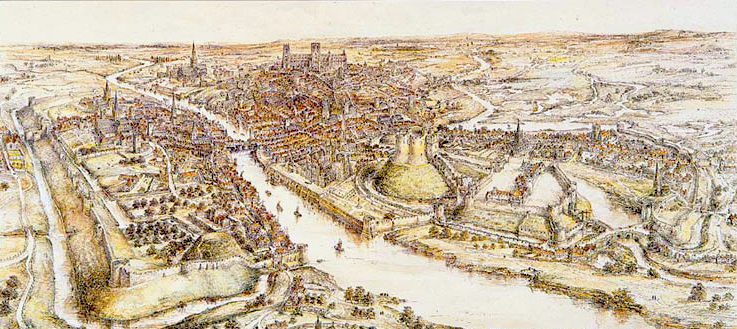
A panoramic view of York in the 15th century. By E. Ridsdale Tate. via Wikimedia Commons

York had been a large trading centre in Northern Europe since before the Norman conquest.[10] And in the 12th century York was the only centre north of the Humber to have a prevalent Jewish community apart from Newcastle-upon-Tyne.[11] Even so, it was likely to have had a very small population, with literary sources putting the population at some 150 members in 1190, which would fit in with the findings of the archaeological investigation, which places the median Jewish population of York at 250.[12] The total Jewish population in 1200 is estimated at being between 4-5000, only 0.25% of the English population.[13] The Jewish population was never a member of any urban commune in which they lived,[14] so a Jew could live within the confines of the city walls, could participant in urban life, but was not a full citizen of the community. Most Englishmen would never have interact with Jews, and even if they did they would unlikely be able to tell that they were Jewish.[15] Some of this tiny percentage of the population did however play an important economic and social function in the medieval town, as moneylenders. Usury was anathema in Christian doctrine, but as the urban economy expanded throughout northern Europe it was becoming an economic necessity. The Jewish population steps in to fill this gap in the market by subverting Church doctrine that forbade usury between Christians.[16] Usury was, however, also sinful in the Jewish tradition, but only when dealing with their coreligionists.  By acting as moneylenders to the Christian mercantile and landed population, but at the same time supporting their own members by lending without interest, would help to strengthen the community, but would also lead to a hardening of opinion by wider English society, of Jews taking advantage of Christians.[17]

While he was certainly not indicative of the social and economic position of the Jewish community as a whole, the most well-known and wealthiest of these Jewish moneylenders in this period was Aaron of Lincoln, who had extensive properties and dealings in York.[18] His vast wealth, along with those of the other members of the Jewish banking community, was exploited by the English crown in order to increase its own revenues, with increased taxes and other duties acting as compensation for their protection.[19] This exploitation of the wealthiest by the crown reflected how the royal bureaucracy acted towards the entirety of the Jewish population, whose use as a milch cow to finance the state was not limited to just the wealthiest of the financiers, but the whole community. When the Duke of Austria captured Richard I when he was returning from crusade the cost to pay his £100,000 ransom fell heavily on the Jewish community, who, as a whole paid, 5,000 marks, which was three times what the citizens of London had to pay.[20] When the crown demanded more wealth from the Jewish population they were forced to call in their debts,[21]

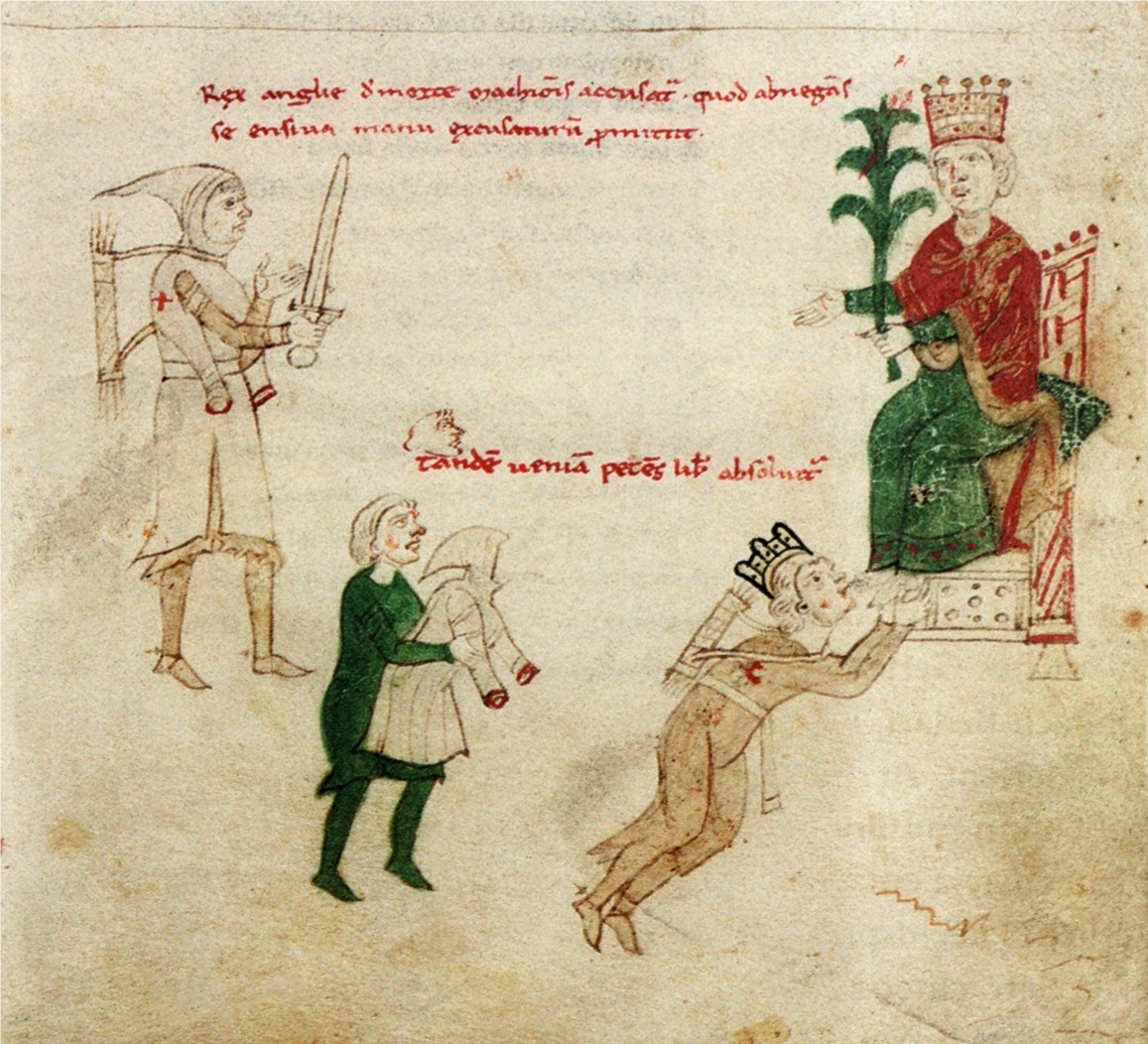
Heinrich VI. begnadigt Richard Loewenherz.jpg
By Petrus de Ebulo – Gerd Althoff, Hans Werner Goetz, Ernst Schubert –- Menschen im Schatten der Kathedrale, Darmstadt: Primus Verlag 1998 S. 18 (Scan) ISBN 3-89678-090-5 (Burgerbibliothek Bern, Cod. 120.II, f. 129r aus der Handschrift Petrus de Ebulo, Liber ad honorem Augusti), Public Domain, Link

One such financier was Josce of York, who was the community leader in the York Jewry. From a bond, it seems as though he was a financial subordinate to Aaron of Lincoln, which would back Dobson’s speculation that a Jewry would not be formed in a town without the support of one of the powerful Jewish magnates to offer protection and support.[22] Further evidence of the link between the Jewish communities of the two towns can be found in the joint purchase of a garden in Barkergate by the two communities.[23]

Ephraim of Bonn, writing about the massacre, shows the Jewish community in England connected to that on the continent.[24] It is following the massacre that we learn of the cultural strength of York, Rabbi Yom-tob of Joigny, and Rabbi Ellijah, were both learned scholars who have travelled to York from the continent.[25] Yom-tob was a well-known poet and legalist, while Elijah was often cited by Rabbinical literature on continental Europe, and Josce of York was praised by continental Jewish writers for his liberality toward legal students.[26] In an extract of Ephraim of Bonn we can tell that a large number of books were written by members of the York Jewry, and that these books were ‘precious as gold and as much fine gold, there being none like them for their beauty and splendour.’[27] The Jewish community was highly literate, presumably because all Jewish men participated in synagogue services, which required the ability to read. This had the knock-on effect on relations with the wider community, as Jews tended to be more educated than their Christian counterparts, which would lead Thomas of Chobham to warn his fellows that ‘the Jews are learned in the law, so they can … easily corrupt Christians’.[28] This suspicion of education may seem a bit outrageous but was taken very seriously by church authorities. Hugh de Puiset, bishop of Durham, received a letter from Pope Alexander III urging him to contain the Jewish superstitio (beliefs outside of Christian doctrine) and perfidia (faithlessness).[29] Stories of the perfidious nature of the Jew were common, such as one related by Roger of Howden where Benedict of York, who was forcibly converted to Christianity by a mob at the coronation of Richard I, but then was subsequently accused of reverted to his previous Judaism, is denounced as doing so as a dog returns to his vomit, using a particularly colourful aphorism from the Book of Proverbs to describe foolish and sinful behaviour. [30] That a converted Jew would regress was a constant fear, and so even converted Jews remained the object of scrutiny and suspicion.

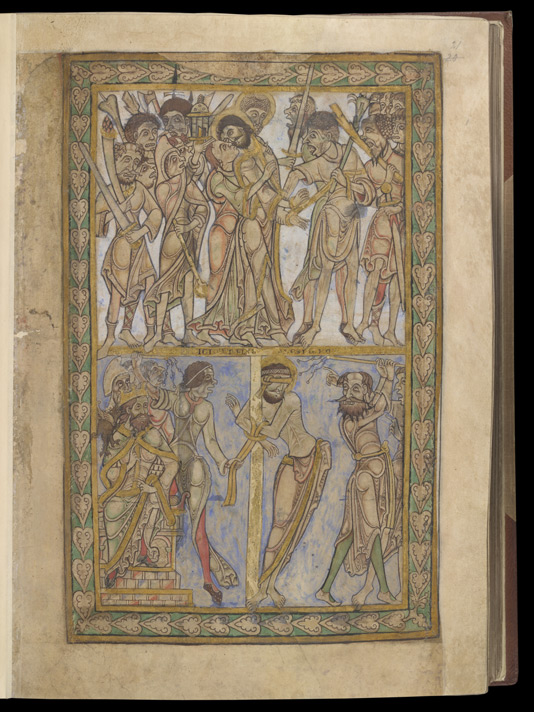
The Betrayal and Flagellation of Christ
Betrayal and Flagellation, in The Winchester Psalter, from the British Library

Jewish middlemen and agents in Yorkshire were involved in many financial transactions with gentiles in the surrounding area, and there were concerns among the landed nobility about their involvement. An example of such a charter from Yorkshire, dating to sometime before 1175, was carefully worded to exclude the possibility of machinamentum collusionis (device of collusion) by which a fee would be extracted, and to prevent the mortgaging of land.[31] Some of these landed nobility, such as Richard Malebisse, William Percy, Marmeduke Darell, and Philip de Fauconberg would be involved in the massacre in 1190. Malebisse, along with Robert of Ghent and Robert of Turnham had been indebted to Aaron of Lincoln.[32] Theses debts of the barons had been taken up by the crown upon his death, and Aaron’s retainers were tasked by the crown with the collection of payment.[33]

All this tension between social groups in York came to a head with the massacre in 1190 on the Shabbat-ha-Gadol, the Sabbath before Passover. It was part of a wider phenomenon of assaults on Jewish communities throughout England and Western Europe.[34] Henry II had just died, and his successor King Richard I had been in open rebellion against his father not long before his death. This instability in the royal position, coupled with the crusading fervour surrounding the call of the Third Crusade were contributing factors in the creation of the environment that allowed for the massacre. Fanaticism swept all classes in England[35] with the violence against the Jewish community mostly being driven by their debtors.[36] The Jewish population in England was always under threat during times of instability when they were without royal protection and this was the case in 1189-90.[37] This reliance took on a greater significance following the Assize of Arms 1181, which both required the Christian population to be armed, and forbade the Jewish population from arming itself.[38] By the requiring the armament of the Christian population, and banning that of the Jewish the Henry II forced the Jews to rely even more heavily on the crown for protection and defence and, as in this case, when the crown was unable or unwilling to extend this protection disaster followed. The northern baronies had always been insubordinate to the Norman and Angevin kings, and at Richard’s ascension to the throne royal authority in the north was almost non-existent.[39]

When a fire broke out in the city a number of the residents of York used the opportunity to break into the house of Benedict of York, and murdered his widow and looted and burnt the building. The Jewish population retreated to the keep in the town to seek refuge from the mob, as the royal sheriff was responsible for the protection of the Jews in each city and barred the doors.[40] Those who remained outside the keep were killed. Fearing treachery, they refused the castellan of the keep admittance, who called for the assistance of the sheriff, John Marshall, and besieged the keep. They were joined in this by the mob, whose leader was an armoured preacher shouting ‘destroy the enemies of Jesus’, and whose death when a rock fell from the castle walls served to further enflame the mob.[41] It was Yom-Tob of Joigny who encouraged the Jews of York to martyr themselves by committing suicide, an act which had a powerful resonance with Jewish history from antiquity, where the Jewish garrison famously did so at the Siege of Masada in 74 AD. They set their possessions on fire, and then began to kill one another. Josce and Yom-Tob were the last to die as Yom-Tob first killed Josce, and then himself. [42] Those who did not commit suicide, or had not perished in the subsequent fire, were put to the sword by the mob when the keep was breached, even after they had offered to convert to Christianity.[43] In the aftermath of the massacre William Longchamp, who was to rule England as regent in the king’s name while Richard was on Crusade, confiscated property from seven of the barons who participated, after they had fled to Scotland, fined around 50 of the burghers, and took hostages from them. The sheriff of York was removed and replaced with Longchamp’s brother, but not one of the participants faced capital punishment for the crime.[44] Richard would later institute the Capitula Judeorum, more out of indignation for the flaunting of royal authority than any worry over the safety of the Jewish population.[45] This edict meant that a record was to be kept for all dealings by Jewish businesses, and a copy of all contracts made between Jews and Christians would stay in the hands of the crown.[46]

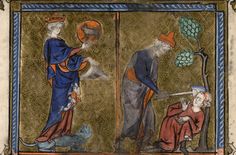
Cain kills Abel, La Somme le Roi
Cain killing Abel, from La Somme le Roi

One of the primary sources available for the massacre is William of Newburgh, who de-emphasised the role that crusading fervour played, and concentrated on the greed and envy of the perpetrators.[47] During the First Crusade there are numerous accounts of crusading groups targeting Jewish communities in Europe on their way to the Holy Land, and this massacre seems to have been in the same vein. Among the Christian chroniclers who mention it only Ralph of Diss outright condemned the massacre, ending his account of it with ‘It cannot be believed that so sad and fatal a death of the Jews can have pleased prudent men, since that saying of David so often comes to our ears – “Do not slay them.”’[48] The massacre did not completely destroy the Jewish population in York where occupation continued, unlike at Bury St Edmunds, whose Jewish population was massacred the day after the fire at Clifford’s Tower.[49] They would hold out for another hundred years until Edward Longshanks’ Edict of Expulsion in 1290, which was enforced for 350 years.

A study into the Jewish community in England under the Norman and Angevin kings reveals that the Jewish community played a vital role in the economic development and growth during the twelfth and thirteenth centuries, which would go unrecognised by most of English society, and was resented by those who benefited from Jewish credit. Much of the English population would never have seen a Jew, or if they had would rarely have had interactions with them, and yet due to their position outside of the established social order, the incredible wealth of some of their members, and the mysticism and suspicion that surrounded them, as well as their supposed betrayal of Christ, the Jewish population in York, and the rest of England remained the subject of persecution, exploitation, and murder. The protection offered to the Jews by the monarchy often left them exploited by their protector, and placed them in an uncomfortable position of prominence within the state, and supposed wealth without participation in English society. The massacre at York in 1190 is a reminder of the fragility of peace in medieval society, where a breakdown in royal authority allowed for the butchery of a marginalised group supposedly under the king’s protection, and how a group living within the state that is outside the social order of the state will often be regarded with fear, suspicion, and hatred.

Bibliography

  • Chazan, Robert. European Jewry and the First Crusade. Berkeley, 1987.
  • Chazan, Robert. The Jews of Medieval Western Europe. Cambridge, 2006.
  • Dobson, R. B. ‘The Jews of Medieval York and the Massacre of March 1190’ in The Jewish Communities of Medieval England: The Collected Essays of R. B. Dobson pp 1- 50. York, 2010.
  • Hillaby, Joe. ‘Jewish Colonisation in the Twelfth Century’ The Jews in Medieval Britain: Historical, Literary, and Archaeological Perspectives edited by Patricia Skinner, pp 15-40. Woodbridge, 2003.
  • Hyams, Paul. ‘The Jewish Minority in Medieval England, 1066-1290’ Journal of Jewish Studies 25 no. 2 (Summer, 1974), pp 270-293.
  • Johnson, Paul. A History of the Jews. New York, 1987.
  • Lilley J. M. et al. ‘The Jewish Burial Ground at Jewbury’ The Archaeology of York: 12/3 pp 295-578. York 1994.
  • Medieval Sourcebook. Ephraim of Bonn. The York Massacre 1189-90 translated by Cecil Roth. http://sourcebooks.fordham.edu/halsall/source/ephr-bonn1.asp
  • Mey, Jacob L. ‘Ephraim of Bonn and the Slaughter of Isaac’ RASK: International Journal of Language and Communication No. 23 (2006), pp 119-129.
  • Parkes, James. The Jew in the Medieval Community. New York, 1976.
  • Powell, Daniel. ‘Belief, History, and Engaging the Other: The View from Clifford’s Tower’ Religion & Literature 44 no. 3 (Autumn 2012), pp 176-185.
  • Richardson, H.G. The English Jewry under the Angevin Kings. London, 1960.
  • Roth, Cecil. A History of the Jews in England. Oxford, 1964.
  • Sapir Abulafia, Anna. ‘William of Newburgh on the attack on the Jews of York in 1190.’ Jewish/Non-Jewish Relations. https://jnjr.div.ed.ac.uk/primary-sources/medieval/william-of-newburgh-on-the-attack-on-the-jews-of-york-in-1190/
  • William of Newburgh. The History of English Affairs: Book II translated by P. G. Walsh & M. J. Kennedy. Cambridge, 2007.

Footnotes

[1] Robert Chazan, The Jews of Medieval Western Europe (Cambridge, 2006), p. 154.

[2] Chazan, The Jews of Medieval Western Europe, p. 15.

[3] Cecil Roth, A History of the Jews in England (Oxford, 1964), p. 22.

[4] R. B. Dobson, ‘The Jews of Medieval York and the Massacre of March 1190’ The Jewish Communities of Medieval England: The Collected Essays of R. B. Dobson (York, 2010), p. 4.

[5] J. M. Lilley et al, ‘The Jewish Burial Ground at Jewbury’ The Archaeology of York: Volume 12 (York, 1994), p. 295.

[6] Robin Mundil. The Kings Jews: Money, Massacre, and Exodus in Medieval England (London, 2010) p. 46.

[7] Joe Hillaby, ‘Jewish Colonisation in the Twelfth Century’ The Jews in Medieval Britian: Historical, Literary, and Archaeological Perspectives ed. Patricia Skinner (Woodbridge, 2003), p. 19.

[8] William of Newburgh, The History of English Affairs Book II, trans. P.G. Walsh & M.J. Kennedy (Oxford, 2007), p. 6.

[9] Roth, A History of the Jews in England, p. 12.

[10] James Parkes, The Jew in the Medieval Community (New York, 1976), p. 312.

[11] Dobson, ‘The Jews of Medieval York’, p. 10.

[12] Lilley, ‘The Jewish Burial Ground at Jewbury’, p. 540.

[13] Paul Hyams, ‘The Jewish Minority in Medieval England’ Journal of Jewish Studies 25 no. 2 (Summer, 1974), p. 271

[14] H. G. Richardson, The English Jewry under the Angevin Kings, (London, 1960), p. 83.

[15] Mundil, The Kings Jews, p. 43.

[16] Chazan, The Jews of Medieval Western Christendom, p. 218.

[17] Paul Johnson, A History of the Jews (New York, 1987), p. 272

[18] Roth, A History of the Jews in England, p. 22.

[19] Chazan, The Jews of Medieval Western Europe, p. 159.

[20] Roth, A History of the Jews in England, p. 27.

[21] Mundil, The Kings Jews, p. 42.

[22] Dobson, ‘The Jews of Medieval York’, p. 8.

[23] Lilley, ‘The Jewish Burial Ground at Jewbury’, p. 305.

[24] Ephraim of Bonn. http://sourcebooks.fordham.edu/halsall/source/ephr-bonn1.asp

[25] Dobson, ‘The Jews of Medieval York’, p. 10.

[26] Roth, A History of the Jews in England, p. 25.

[27] Ephraim of Bonn.

[28] Thomas of Chobham, Summa confessorum cited in Hyams ‘The Jewish Minority in Medieval England’, p. 286.

[29] Dobson, ‘The Jews of Medieval York’, p. 12.

[30] Hyams, ‘The Jewish Minority in Medieval England’, p. 276.

[31] Hyams, ‘The Jewish Minority in Medieval England, p. 292.

[32] Mundil, The Kings Jews, p. 81.

[33] Anna Sapir Abulafia, ‘William of Newburgh on the attack on the Jews of York in 1190’ Jewish/Non-Jewish Relations https://jnjr.div.ed.ac.uk/primary-sources/medieval/william-of-newburgh-on-the-attack-on-the-jews-of-york-in-1190/

[34] Chazan, The Jews of Medieval Western Europe, p. 160.

[35] Roth, A History of the Jews in England, p. 18.

[36] Parkes, The Jew in the Medieval Community, p. 371.

[37] Chazan, The Jews of Medieval Western Europe, p. 157.

[38] Roth, A History of the Jews in England, p. 19.

[39] Sapir Abulafia, ‘William of Newburgh’

[40] Richardson, The English Jewry under Angevin Kings, p. 110.

[41] Mundil, The Kings Jews, p. 80.

[42] Roth, A History of the Jews in England, p. 23.

[43] Daniel Powell, ‘Belief, History, and Engaging the Other: The View form Clifford’s Tower’ Religion & Literature 44 no. 3 (Autumn, 2012), p. 180.

[44] Roth, A History of the Jews in England, p. 26.

[45] Hillaby, ‘Jewish Colonisation in the Twelfth Century’, p. 31.

[46] Chazan, The Jews of Medieval Western Europe, p. 161.

[47] Robert Chazan, European Jewry and the First Crusade (Berkeley, 1987), p. 190.

[48] Ralph of Diss Ymagines historiarum quoted in Mundil The Kings Jews, p. 80.

[49] Mundil, The Kings Jews, p. 82